3D surface reconstruction
Terrain, buildings, cliffs and quarries reconstructed to a measurable surface — from national LiDAR, drone photogrammetry, or Gaussian splats, whichever the site allows.
LiDAR HD · photogrammetry · splats
Extralabs turns ordinary capture — a drone pass, a street panorama, national LiDAR — into measured 3D surfaces you own. Position is recovered from the imagery itself, so a site can be surveyed even where the sky is a sliver.
Acquiring 3D data has never been the hard part — sensors are everywhere. The hard part is that the data arrives fragmented and heterogeneous, and turning it into one coherent, current model of a place has meant commissioning a survey campaign.
We reconstruct that fragmented capture into detailed, evolving surfaces, and we do it on open infrastructure. That matters for two reasons: a public body can keep its data inside its own jurisdiction, and anyone can verify how a number was produced.
For local government, infrastructure operators, and anyone responsible for ground that has to stay where it is.
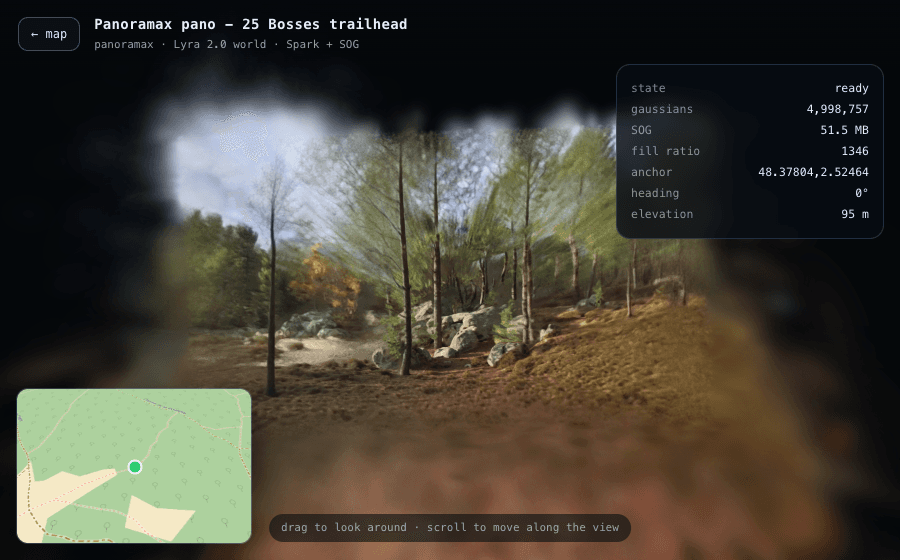
35 worlds across two forest sites, over 33 million gaussians in all. Neither was placed by satellite fix: every one came out of the pipeline described here, and both sites are open in the browser.
A drone pass, a phone panorama, or imagery you already hold. No surveyed control point and no satellite fix needed at capture time.
The footage becomes geometry through open world-model reconstruction, with high-density splats carrying the fine surface.
Registered against open geodata — street network, national terrain and elevation models, existing LiDAR — so it lands in a real coordinate system.
A visual positioning system resolves where each capture sits, and re-resolves it on every later visit. Position becomes a measurement, not an assumption.
National LiDAR is the ground-truth base layer, splats are superimposed on it, and differencing two epochs gives the movement with its uncertainty stated.
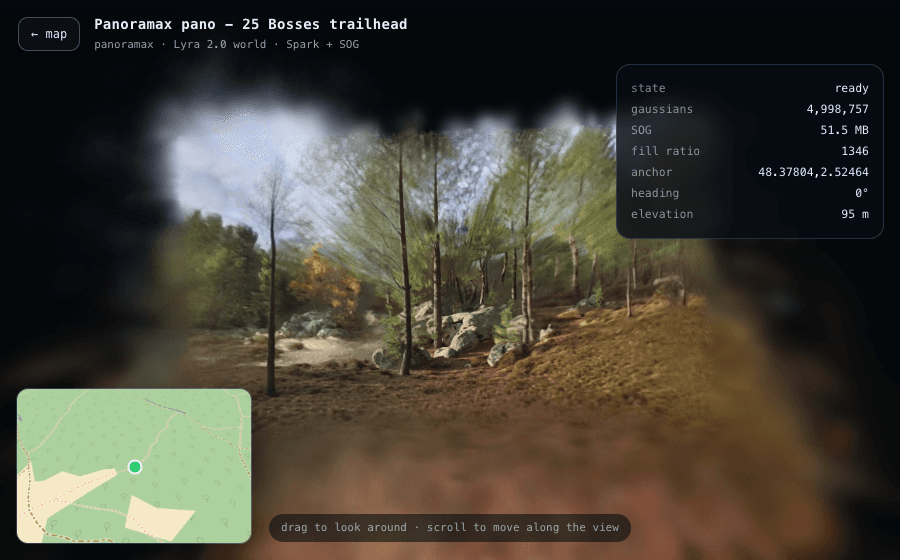
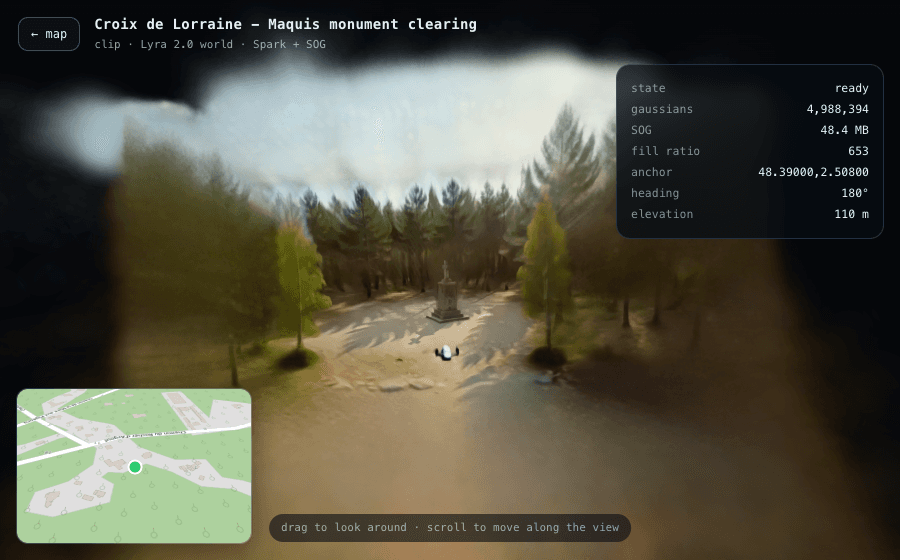
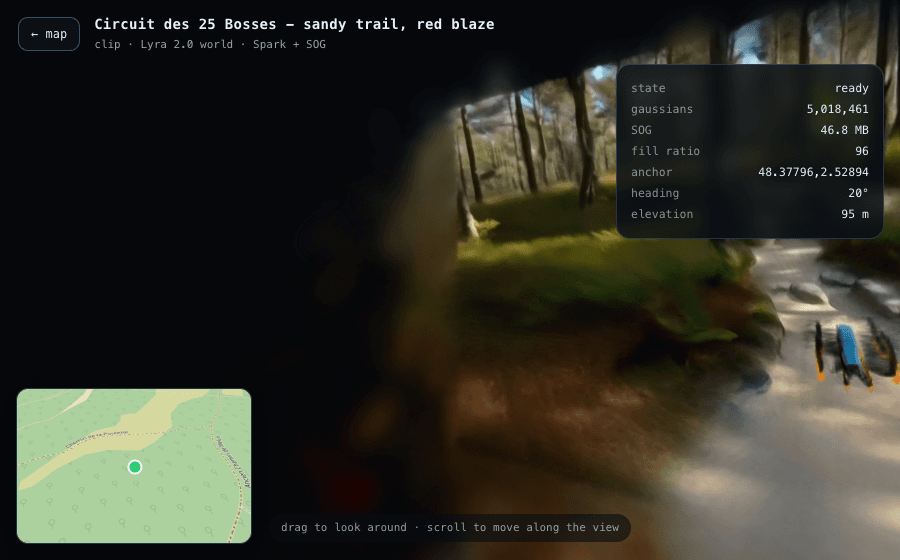
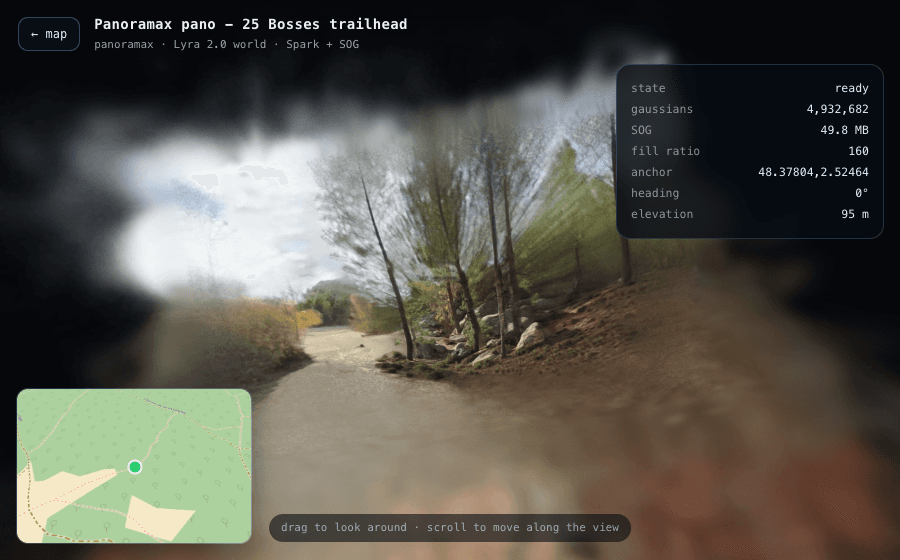
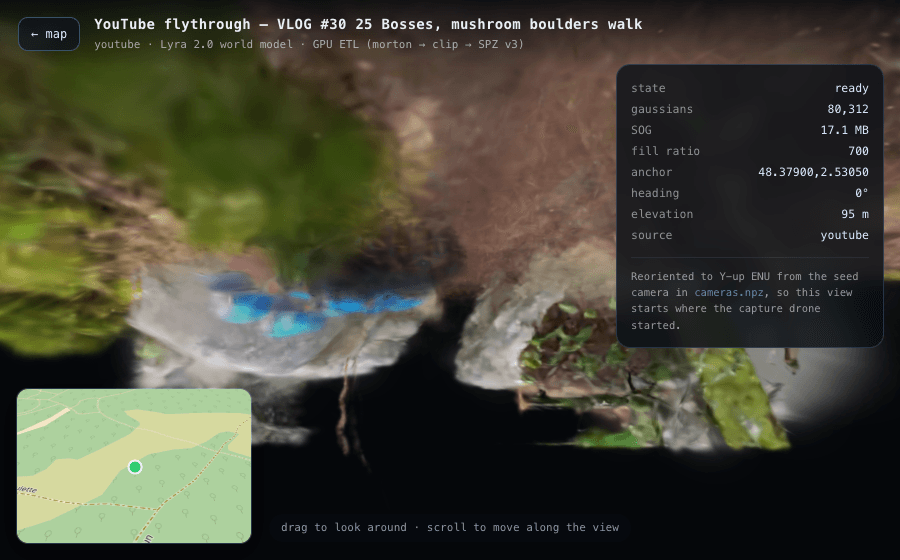
See them moving
The reconstructions stream into the browser — orbit them, and read the station record beside each one.
Open the live reconstructions →Open the anchored forest map →Five services, in the order they usually matter to a site owner.
Terrain, buildings, cliffs and quarries reconstructed to a measurable surface — from national LiDAR, drone photogrammetry, or Gaussian splats, whichever the site allows.
LiDAR HD · photogrammetry · splats
The same site observed again and differenced against its own history. That is the signal behind rockfall, erosion, subsidence, and encroaching fuel load.
movement · erosion · fuel load
Under heavy canopy, inside a quarry, against a cliff face, or in a street where the sky is a sliver — places where a GNSS fix is unavailable and a survey still has to be possible.
visual positioning · repeatable
The pipeline is assembled from open components and runs on infrastructure you or your jurisdiction controls. There is no vendor cloud in the path, so there is nothing to ship data to.
open stack · your estate
Reconstructed surfaces delivered as the formats your teams already use — streamable splats, tiled point clouds, elevation models, and watertight meshes.
splats · tiles · DEM · meshes
Named work, in plain language — what it is, and what it proves.
Nine reconstructions of a sandstone boulder circuit under heavy canopy, where a GNSS fix does not reach. 26.8 million gaussians across 9 worlds, 299.7 MB streamed to the browser, built from world-model output, panoramas and a public flythrough.
Twenty-six of 34 phone clips, each reconstructed independently along a 2.36 km forest route into 6,237,739 gaussians (96.0 MB), over a 220,000-point IGN LiDAR HD base layer. Both tiers are stated and neither is survey grade: 14 worlds anchored within 15 m, 12 coarse approximations to 532 m.
Ingestion and processing of France’s national LiDAR product as the survey-grade ground-truth surface. Reconstructions are superimposed on the LiDAR-derived mesh rather than floating free of it.
Regularised, watertight surface reconstruction from point clouds — the research line our co-founder published on, and the open implementation we build on to turn LiDAR into measurable surfaces rather than loose point soup.
Pose estimated from imagery alone and served as a geospatial position: location plus orientation with an accuracy figure. This is what lets a capture be placed without a satellite fix.
Ingestion, tiling, geo-registration, reconstruction and serving, run as resumable stages on GPU. It is the same pipeline every reconstruction above came out of.
A simulated drone eye over a reconstructed site, generated as short cinematic clips and turned back into geometry — useful for planning a flight, and for showing a site to people who cannot visit it.
We would rather show what exists than promise what might.
Two forest sites reconstructed from mixed capture. 35 worlds published over a national LiDAR base layer, with placement accuracy stated where it is known: the 26 Verrières worlds tiered from 15 m anchored to 532 m approximate.
A regional pilot with a public partner, wider coverage across Île-de-France, and more capture sources feeding the same pipeline.
Coverage that keeps itself current as the network grows, so nobody has to commission an acquisition campaign to get an up-to-date surface again.
A small team. Between us we cover the science, the commercial model and the engineering — which is why the pipeline is short and nothing in it is a black box.
Sets the direction and the commercial model — sovereign, open infrastructure priced against what you actually measure.
Owns the science: reconstruction, registration, and the change-detection methods the hazard work rests on.
Builds and runs the pipeline, the services, and the browser-based viewer end to end.
Tell us the site and what you need to know about it — movement, erosion, fuel load, or simply a surface you can measure against next season. If we cannot answer it, we will say so.
Or write to us directly at contact@extralabs.xyz